|

| |
While this page is sure to get filled with the latest goings on
in the research being pursued for Dr. Roddick, for now just a brief synopsis of the
current state of affairs. I am working with electrophilic metal centers. Mostly Pt
moieties are being probed. We use a teflon coated perfluoroalkyl phosphine ligand known as
dfepe 1,2 bis(pentafluoroethyl)phosphinoethane. This ligand is a CO mimic with
spectroscopic handles and steric bulk. The platinum square planar molecules are being
tested for reactivity with weakly coordinating anions such as: L = OTf, fluorosulfanato,
fluoroantimonate, Barf, triphenylborane,etc.
So far in we jave made several stable CO cationic complexes
in situ and even with my golden synthetic hands crystal cultivation is slow. We
have come close with several complexes but so far oils are our only product.
Here is the first communication I have had published. It made JACS
yippee!
[PDF version of this article]
Organometallics in Superacidic Media:
Generation of Highly Electrophilic (Fluoroalkyl)phosphine Pt(II) Cationic Complexes
James F. Houlis and Dean M. Roddick*
Contribution from the Department of Chemistry, Box
3838
University of Wyoming, Laramie, Wyoming 82071
Abstract
Preliminary investigations of (dfepe)Pt(II)
(dfepe = (C2F5)2PCH2CH2P(C2F5)2)
coordination chemistry in superacidic media are reported. Displacement of anionic ligands
from (dfepe)Pt(X)2 and (dfepe)Pt(Me)(X) (X = OTf, FSO3) by carbon
monoxide is not observed in aprotic organic solvents. In contrast, treatment of these
compounds in their neat respective acids with 1 atm CO cleanly affords the monocarbonyl
cations (dfepe)Pt(X)(CO)+ (X = OTf, n(CO) = 2210 cm-1; FSO3,
n(CO) = 2212 cm-1) and (dfepe)Pt(Me)(CO)+ (n(CO) = 2174 cm-1).
In the case of X = FSO3, higher pressures of CO (100 psi) lead to the
reversible formation of the dicarbonyl dication, [(dfepe)Pt(CO)2]2+
(n(CO) = 2235, 2221 cm-1). The methyl cation (dfepe)Pt(Me)(CO)+ is
remarkably resistant to Pt-C bond protonolysis even in SbF5/SO2/FSO3H
superacid mixtures. Dissolution of (dfepe)Pt(OTf)2 or (dfepe)Pt(Me)2
in neat SbF5 cleanly yields a weakly associated solution species formulated as
(dfepe)Pt(F(SbF5)n)2, which reacts with CO to directly
form stable solutions of [(dfepe)Pt(CO)2]2+. Treatment of
(dfepe)Pt(Me)2 with 4 equiv. SbF5(SO2) in SO2
affords a thermally unstable methyl product tentatively assigned as (dfepe)Pt(Me)(F(SbF5)n);
in pentafluoropyridine the adduct (dfepe)Pt(Me)(NC5F5)+
is obtained.
Introduction
The chemistry of highly electrophilic late
transition metal centers has received increasing attention in recent years.1 In
the context of "Shilov chemistry", the involvement of cationic Pt(II) centers in
hydrocarbon activation has been recently demonstrated by several groups for L2Pt(R)X
systems.2,3 A key for electrophilic group 10 studies has been the use of
weakly-coordinating anions such as B[3,5-C6H3(CF3)2]4-
and MeB(C6F5)3-, which allow the incipient
generation of reactive 14-electron metal centers.2-4 Several years ago we
reported the synthesis of very electron-poor (perfluoroalkyl)phosphine complexes
(dfepe)Pt(Me)X (dfepe = (C2F5)2PCH2CH2P-(C2F5)2;
X = O2CCF3, OTf, SO3H).5 While these systems
could in principle afford an extremely electrophilic (dfepe)Pt(Me)+ moiety,
simple anion dissociation is greatly disfavored and ligand association reactions to form
(dfepe)Pt(Me)(L)+ products are not observed.6
A different approach was suggested by the unusual
stabilities of (dfepe)Pt(Me)X and (dfepe)Pt(X)2 compounds in the protic
superacids CF3SO3H and FSO3H,5,7 together with
Aubke’s novel syntheses of unusual cationic metal polycarbonyl complexes, M(CO)nm+,
which exploit the inherently low nucleophilicity of superacidic media.8,9 In
this report we show that well-defined (dfepe)Pt(II) coordination compounds with accessible
coordination sites may be generated in superacidic solvent systems, the utility of SbF5(SO2)
as a stoichiometric reagent for the generation of weakly-associated LnM+[(X)(SbF5)n]-
organometallics, and some initial observations regarding the stabilization of transition
metal-carbon bonds in superacidic media.
(dfepe)Pt(X)2 (X = OTf, FSO3)
complexes have very limited solubilities in aprotic solvents and do not react with CO. In
fluorosulfonic acid, however, treatment of (dfepe)Pt(FSO3)2 with 1
atm CO cleanly generates a cationic monocarbonyl product [(dfepe)Pt(CO)(FSO3)]+
(1) (n(CO) = 2214 cm-1) (Equation 1). Under higher pressures of
CO (>40 psi) the reversible appearance of an additional single 31P resonance
and two new n(CO) bands at 2235 and 2222 cm-1 are attributed to generation of
[(dfepe)Pt(CO)2]2+ (2). In triflic acid, only
[(dfepe)Pt(CO)(OTf)]+ (3) (n(CO) = 2210 cm-1) is
observed under these conditions.10 Both 1 and 3 in
the absence of CO only slowly revert to (dfepe)Pt(X)2 at 20 ºC over several
days. This acid-dependent carbonylation behavior has been previously attributed to the
formation of more weakly coordinating hydrogen-bonded anion aggregates, X(HX)n-.11,12

Aubke has reported that dissolution of simple
transition metal salts in the neat Lewis superacid SbF5 in the presence of CO
leads to X- abstraction and the formation of novel polycarbonyl polycations
such as Pt(CO)42+, Ir(CO)63+, and Fe(CO)62+
with Sb2F11- conteranions.8,13 Treatment of
the donor phosphine complex (dmpe)Pt(Me)2 with SbF5 at 20 ºC does
not afford any identifiable soluble products. In contrast, both (dfepe)Pt(Me)2
and (dfepe)Pt(OTf)2 dissolve readily in SbF5 and cleanly generate a
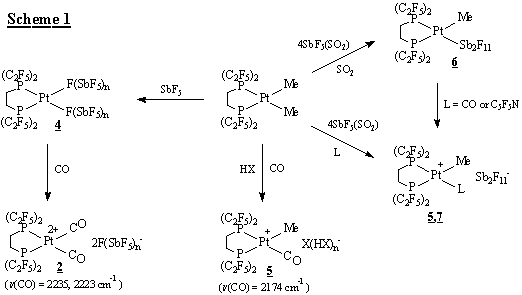
common (dfepe)Pt(X)2 solution species 4 exhibiting a single 31P
NMR resonance at d 65.0 (1JPtP = 4530 Hz) (Scheme 1).14
Although we have not yet directly determined the nature of the counteranion X in this
solvent, the 1JPtP for this complex is significantly higher than
that observed for (dfepe)Pt(OTf)2 (1JPtP = 4210 Hz) and
is clearly indicative of a more weakly coordinating SbF6(SbF5)n-
counteranion such as SbF6- or Sb2F11-.15
Similar treatment of (dfepe)Pt(Me)2 with FSO3H:SbF5
mixtures ranging from 5% to over 90% SbF5 uniformly produce (dfepe)Pt(X)2
solution species with a slightly lower 1JPtP of 4350 Hz; anions of
the general form (FSO3)nSbF6-n are likely under these
conditions.16 The stability of 4 in pure SbF5 is
remarkable: no spectral changes were noted by 31P NMR after 5 hours at 120 ºC.
Complex 4 is exceedingly soluble in both SbF5 and SbF5/FSO3H,
and thus far attempts to isolate pure crystalline materials from these solutions have not
been successful.
The reactivity of 4 is consistent
with its formulation as an incipient source of "(dfepe)Pt2+":
treatment with 2 atm of CO at 20 ºC produces (dfepe)Pt(CO)22+ (2)
(n(CO) = 2235, 2223 cm-1), with no evidence for monocarbonyl formation. The
value of n(CO)ave (2229 cm-1) for this nonclassical17
dicarbonyl dication is intermediate between n(CO)ave reported for the neutral
Pt(II) complex (FSO3)2Pt(CO)2 (2202 cm-1) and
the tetracarbonyl dication, Pt(CO)42+ (2261 cm-1).8d,18
The electron-poor nature of 2 is further reflected by the unusually
high-field 13C NMR carbonyl resonance at d 152.6, which appears as a doublet
due to coupling to the trans phosphorus (2JPC = 132 Hz).19
Taken together, the platinum carbonylation data in HOTf, FSO3H, and SbF5
are in accord with a relative anion lability ordering Sb2F11-
> SO3F- > OTf -.
Acid-assisted anion labilization is also observed
in (dfepe)Pt(Me)(X) systems: Unlike carbonylations of (dfepe)Pt(Me)(OTf) in aprotic
solvents, which result in reduction to give (dfepe)Pt(CO)2,6,20
exposure of either triflic or fluorosulfonic acid solutions of (dfepe)Pt(Me)(OTf) and
(dfepe)Pt(Me)(FSO3), respectively, to 1 atm CO cleanly generates
(dfepe)Pt(Me)(CO)+ (5) (n(CO) = 2174 cm-1). The n(CO)
value for 5 appears to be the highest yet reported for a metal-alkyl
complex. The methyl cation 5 also exhibits the highest protolytic stability
of any transition metal organometallic system yet reported: Compared to (dfepe)Pt(Me)(FSO3),
which completely converts to (dfepe)Pt(FSO3)2 in FSO3H in
less than 4 hours at 20 ºC, FSO3H solutions of 5 in the absence
of ambient CO pressure slowly convert to the monocarbonyl cation 1 with a
half-life of approximately 3 days. In a 0.2:0.2:1 mixture SO2:SbF5:FSO3H,
ca. 70% unreacted 5 is observed after 1 hour.
Identifiable (dfepe)Pt(Me)(X) products were not
obtained by treatment of (dfepe)Pt(Me)2 with either "C5F5NH+[B(Arf)4]-"2
or B(C6F5)3 in pentafluoropyridine. However, addition of
three equivalents SbF5(SO2),21 (a convenient crystalline
source of antimony pentafluoride) to (dfepe)Pt(Me)2 in SO2 at
–20 ºC produces a thermally unstable species tentatively formulated as
(dfepe)Pt(Me)(Sb2F11) (6).22,23 The
corresponding reaction in pentafluoropyridine gave (dfepe)Pt(Me)(C5F5N)+Sb2F11-
(7), which could be obtained as a pale-violet oily solid. Both 6
and 7 serve as labile sources of (dfepe)Pt(Me) cations: exposure of either 6
or 7 to 1 atm CO results in quantitative conversion to (dfepe)Pt(Me)(CO)]+.
No CO insertion into the Pt-Me bond is observed 5 after hours at ambient
temperature and at pressures up to 100 psi. Preliminary ligand exchange studies for the
(dfepe)Pt(Me)(L)+ give a relative binding affinity ordering of L = MeCN >
acetone > CO > C5F5N > SO2.
In summary, by exploiting both superacidic
solvent systems and the Lewis superacidic reagent SbF5(SO2), we been
able to generate labile, highly electron-poor platinum cationic systems with well-defined
(fluoroalkyl)phosphine coordination spheres. The cationic methyl complexes
(dfepe)Pt(Me)(L)+ in particular provide an important bridge between purely
inorganic metal superacids and true organometallic systems,9b and afford the
opportunity for fundamental studies of metal-mediated hydrocarbon conversions in this
extreme medium. Efforts are currently underway to further characterize these and related
(fluoroalkyl)phosphine metal complex systems and explore their coordination chemistry.
Acknowledgments. This work has been supported
by the National Science Foundation (Grant CHE-9615985), the Wyoming DOE-EPSCoR Program,
and the donors of the Petroleum Research Fund, administered by the American Chemical
Society.
References
- a) Shilov, A. E.; Shul’pin, G. B. Chem. Rev. 1997,
97, 2879-2932. b) Periana, R. A.; Taube, D. J.; Evitt, E. R.; Löffler, D. G.;
Wentrcek, P. R.; Voss, G.; Masuda, T. Science 1993, 259, 340-343. c)
Burger, P.; Bergman, R. G. J. Am. Chem. Soc. 1993, 115, 10462-10463.
d) Sen, A. Platinum Metals Rev. 1991, 35, 126-132. e) Kao, L.-C.;
Hutson, A. C.; Sen, A. J. Am. Chem. Soc. 1991, 113, 700-701. f) Sen,
A. Acc. Chem. Res. 1988, 21, 421-428.
- a) Periana, R. A.; Taube, D. J.; Gamble, S.; Taube, H.; Satoh, T.;
Fujii, H. Science 1998, 280, 560-564. b) Holtcamp, M. W.; Labinger,
J. A.; Bercaw, J. E. J. Am. Chem. Soc. 1997, 119, 848-849. c)
Holtcamp, M. W.; Henling, M. L.; Day, M. W.; Labinger, J. A.; Bercaw, J. E. Inorg.
Chim. Acta 1998, 270, 467-478.
- Wick, D. D.; Goldberg, K. I. J. Am. Chem. Soc. 1997,
119, 10235-10236.
- a) Hill, G. S.; Rendina, L. M.; Puddephatt, R. J. J. Chem.
Soc., Dalton Trans. 1996, 1809-1813. b) Johnson, L. K.; Killian, C. M.;
Brookhart, M. J. Am. Chem. Soc. 1995, 117, 6414-6415. c) Rix, F. C.;
Brookhart, M. J. Am. Chem. Soc. 1995, 117, 1137-1138.
- Bennett, B. L.; Birnbaum, J.; Roddick, D. M. Polyhedron 1995,
14, 187-195.
- Peters, R. G.; Bennett, B. L.; Roddick, D. M. Inorg. Chim.
Acta. 1997, 265, 205-211.
- Bennett, B. L.; Hoerter, J. M.; Houlis, J. F.; Roddick, D. M., to
be submitted to Organometallics.
- a) Bley, B.; Willner, H.; Aubke, F. Inorg. Chem. 1997,
36, 158-160. b) Wang, C.; Siu, S. C.; Hwang, G.; Bach, C.; Bley, B.; Bodenbinder,
M.; Willner, H.; Aubke, F. Can. J. Chem. 1996, 74, 1952-1958. c)
Bach, C.; Willner, H.; Wang, C.; Rettig, S. J.; Trotter, S.; Aubke, F. Angew. Chem.
Int. Ed. Engl. 1996, 35, 1974-1976. d) Aubke, F.; Wang, C. Coord.
Chem. Rev. 1994, 137, 483-524.
- a) Olah, G. A.; Surya Prakash, G. K.; Sommer, J. "Superacids",
Wiley-Interscience, New York, 1985. b) O’Donnell, T. A. "Superacids
and Acidic Melts as Inorganic Chemical Reaction Media", VCH Publishers, New York,
1993.
- Selected spectroscopic data for 1: 31P
NMR (FSO3H, 161.97 MHz, 20 ° C): d 75.4 (pseudo pentet, 2JPF(a)
= 2JPF(b) = 52 Hz, 1JPtP= 3210 Hz; P trans to
CO), 65.2 (ps. p, 2JFP= 86Hz, 1JPtP = 3490 Hz;
P trans to FSO3). For 2: 31P NMR (FSO3H,
161.97 MHz, 20 ° C): d 80.4 (m, 1JPtP = 2795 Hz). For 3:
31P NMR (HOTf, 161.97 MHz, 20 ° C): d 74.9 (p, 2JPF = 85
Hz, 1JPtP = 3150 Hz; P trans to CO), 65.3 (p, 2JPF
= 85 Hz, 1JPtP = 3500 Hz; P trans to OTf).
- Souma, Y.; Iyoda, J.; Sano, H. Inorg. Chem. 1976, 15,
968-970.
- Nitschke, J.; Schmidt, S. P.; Trogler, W. C. Inorg. Chem.
1985, 24, 1972-1978.
- Wang, C.; Hwang, G.; Siu, S. C.; Aubke, F.; Bley, B.; Bodenbinder,
M.; Bach, C.; Willner, H. Eur, J. Solid State Inorg. Chem. 1996, 33,
917-930.
- A trifluorophosphine complex, Au(PF3)2+,
has been recently generated under superacidic conditions: Bley, B; Bodenbinder, M; Balzer,
G.; Willner, H.; Hägele, G.; Mistry, F.; Aubke, F. Can. J. Chem. 1996, 74,
2392-2394.
- The correspondence between 1JPtP and anion
s-donor ability is well established: Appleton, T. G.; Clark, H. C.; Manzer, L. E. Coord.
Chem. Rev. 1973, 10, 335-422. See also ref. 5
- a) Brunet, D.; Germain, A.; Commeyras, A. Nouv. J. Chim.
1978, 2, 275-283. b) Olah, G. A.; Commeyras, A. J. Am. Chem. Soc.
1969, 91, 2929-2942.
- a) Rack, J. J.; Strauss, S. H. Catal. Today 1997, 36,
99-106. b) Hurlburt, P. K.; Rack, J. J.; Luck, J. S.; Dec, S. F.; Webb, J. D.; Anderson,
O. P.; Strauss, S. J. J. Am. Chem. Soc. 1995, 116, 10003-10014.
- Selected spectroscopic data for 2: 13C
NMR (SbF5, 100.61 MHz, 20 ° C): d 152.6 (d, 2JPC(trans)
= 132 Hz, 1JPtC = 1330 Hz; Pt(13CO)), 110-120 (m, P(C2F5)),
21.5 (br. s; PCH2). 31P NMR (SbF5, 161.97 MHz, 20 ° C):
d 78.7 (P, 2JPF = 91 Hz, 1JPtP = 2790 Hz).
- d(CO) values as low as 121 ppm have been reported for M(CO)nm+
systems.8
- In contrast to CO addition, (dfepe)Pt(Me)(X) complexes react
readily with H2 in both protic and aprotic solvents to form [(dfepe)Pt(m-H)]2:
Bennett, B. L.; Roddick, D. M. Inorg. Chem., 1996, 35, 4703-4707.
- Aynsley, E. E.; Peacock, R. D.; Robinson, P. L. Chem. Ind.
1951, 1117.
- Solvation to form [(dfepe)Pt(Me)(SO2)]+ has
not been ruled out. Spectroscopy for 6: 1H NMR (SO2,
400.13 MHz, 20 ° C): d 2.77 (m, 2H; PCH2), 2.48 (m, 2H; PCH2), 1.23
(d, 3JPH = 7 Hz, 3H; PtCH3). {1H}13C
NMR (SO2, 100.61 MHz, -10 ° C): d 107 - 124 (m; P(C2F5)),
25.5 (P(CH2)), 15.9 ((P(CH2)), 9.4 (d, 1JPC =
71 Hz, 1JPtC = 1450 Hz; Pt(CH3)). 31P NMR (SO2,
161.97 MHz, -10 ° C): d 88.5 (pd, JPP = 27 Hz, 2JPF = 66
Hz, 1JPtP= 1610 Hz; P trans to Me), 54.6 (pd, JPP = 27
Hz, 2JPF = 68 Hz, 1JPtP = 5920 Hz). 19F
NMR (SO2, 376.49 MHz, -65 ° C): d -79.0 (s, 6F; P(CF2CF3)),
-80.0 (s, 6F; P(CF2CF3)), -106 to –110 (m, 8F; P(CF2CF3)),
-91.2 (br. s, 1F; Sb2(m-F)), -111.8 (br. s, 8F; SbFeq), -133.1 (br.
s, 2F; SbFax).
- The ultimate fate of the abstracted methyl group has not been
determined. 13C NMR spectra indicate no carbon-containing products other than 6
in solution; a small (0.38 H) protic resonance is observed at 13.3 ppm in C5F5N
which is likely produced by the decomposition of an initial abstraction product such as
(Me)SbF5-.
Supplementary Material
General Procedures. All manipulations were
conducted under an atmosphere of nitrogen using Schlenk, high vacuum line and/or glovebox
techniques. All glassware was flame-dried under vacuum prior to use. CF3SO3H,
FSO3H, and SbF5 were vacuum distilled prior to use and stored in
Teflon bottles at –30 ºC under nitrogen. Pentafluoropyridine was dried over
activated 3Å molecular sieves and distilled prior to use. 90% 13CO was
obtained from ICL Laboratories. Infrared spectra were recorded on a Bomem MB-100 FTIR
instrument using either a DuraSamplIR SiComp (silicon element) or ZrComp (zirconia
element) Hastalloy ATR assembly fitted with a locally-designed Kel-F/Teflon pressurizable
reaction chamber. NMR spectra were obtained with a Bruker Avance DRX-400 instrument. 1H
spectra were referenced to external C6D6, unless otherwise noted. 19F
spectra were referenced to CF3CO2Et as an external standard (-75.32
ppm vs. CFCl3 with downfield chemical shifts taken to be positive). 31P
spectra were referenced to a 85% H3PO4 external standard.
(dfepe)Pt(Me)2 and (dfepe)Pt(X)2 (X = OTf, FSO3),5,7
and SbF5(SO2)20 were prepared as described previously.
Carbonylation of (dfepe)Pt(FSO3)2.
A 5mm NMR tube equipped with a Teflon Valve (Wilmad PV-ANV) containing 50 mg of
(dfepe)Pt(FSO3)2 dissolved in 0.5 mL FSO3H was charged
with 1 atm CO. After 1 hr, 31P NMR indicated the complete conversion to
[(dfepe)Pt(CO)(FSO3)]+(FSO3) (1). Further
pressurization to 100 psi resulted in the partial conversion to [(dfepe)Pt(CO)2]2+(FSO3)2
(2). Attempts to isolate 1 from FSO3H by either
cooling or precipitation with aprotic solvents such as ether or triflic anhydride were not
successful. Spectroscopy for 1: 1H NMR (FSO3H, 400.13
MHz, 20 ° C): d 3.78 (m, 2H; PCH2), 3.54 (m, 2H; PCH2). 31P
NMR (FSO3H, 161.97 MHz, 20 ° C): d 75.4 (pseudo pentet, 2JPF(a)
= 2JPF(b) = 52 Hz, 1JPtP= 3210 Hz; P trans to
CO), 65.2 (ps. p, 2JFP= 86Hz, 1JPtP = 3490 Hz;
P trans to FSO3). IR ((FSO3H, ZrO2 ATR): 2214 cm-1.
Spectroscopy for 2: 31P NMR (FSO3H, 161.97 MHz, 20 °
C): d 80.4 (m, 1JPtP = 2795 Hz). IR (FSO3H, 100 psi CO,
ZrO2 ATR): 2235, 2222 cm-1.
Carbonylation of (dfepe)Pt(OTf)2. As
described for 1, 50 mg of (dfepe)Pt(OTf)2 dissolved in 0.5 mL
HOTf was charged with 1.5 atm CO. After 3 hr, 31P NMR indicated the complete
conversion to [(dfepe)Pt(CO)(OTf)]+(OTf) (3). Precipitation of 3
from concentrated acid solutions was not possible. Spectroscopy for 3: 1H
NMR (HOTf, 400.13 MHz, 20 ° C): d d 3.20 (m, 2H; PCH2), 2.89 (m, 2H; PCH2).
31P NMR (HOTf, 161.97 MHz, 20 ° C): d 74.9 (p, 2JPF = 85
Hz, 1JPtP = 3150 Hz; P trans to CO), 65.3 (p, 2JPF
= 85 Hz, 1JPtP = 3500 Hz; P trans to OTf). IR (HOTf, ZrO2
ATR): 2210 cm-1
(dfepe)Pt(SbF6(SbF5)n)2
(4). To an NMR tube containing 50 mg (dfepe)Pt(Me)2 was added
0.5 mL SbF5. Over the course of 30 minutes, a slow evolution of methane
(identified by 1H NMR) was observed and the solution became pale yellow.
Removal of SbF5 by either distillation or repeated trituration with SO2
(removed as SbF5(SO2) sublimate) did not yield a tractable product. 1H
NMR (SbF5, 400.13 MHz, 20 ° C): d d 0.65 (m, PCH2). 31P
NMR (SbF5, 161.97 MHz, 20 ° C): d 65.0 (p, 2JFP= 88 Hz,
1JPtP = 4530 Hz). 19F NMR (SbF5, 376.46 MHz, 20 °
C): d -77.8 (s,12F; CF2CF3), -104.0 (AB portion of ABX
pattern, Dd = 2.95 ppm, 2JFP = 88 Hz, 2JFF =
313 Hz, 8F; PCF2). IR (SbF5, Si ATR, cm-1): 1407(w),
1239, 1310(s), 1248(m), 1228(vs), 1172(m), 1127(s), 973(s).
Carbonylation of (dfepe)Pt(SbF6(SbF5)n)2.
A solution of 4 in SbF5, was exposed to 1.5 atm CO. After 3
hrs, 31P NMR indicated the complete conversion to the dicarbonyl dication 2.
Attempts to isolate 2 by the removal of SbF5 by distillation in
vacuo or by trituration with SO2 were not successful. 1H NMR
(SbF5, 400.13 MHz, 20 ° C): d 1.13 (m, PCH2). 13C NMR
((dfepe)Pt(13CO)22+, SbF5, 100.61 MHz, 20 °
C): d 152.6 (d, 2JPC(trans) = 121 Hz, 1JPtC =
1330 Hz ; Pt(13CO)), 110-120 (m, P(C2F5)), 21.5 (br. s;
PCH2). 31P NMR (SbF5, 161.97 MHz, 20 ° C): d 78.7 (p, 2JPF
= 91 Hz, 1JPtP = 2790 Hz). IR (SbF5, ZrO2
ATR), n(CO): 2235, 2223 cm-1; n(13CO): 2183, 2172 cm-1.
[(dfepe)Pt(Me)(CO)]+ (5).
Exposure of solutions of (dfepe)Pt(Me)(OTf) or (dfepe)Pt(Me)(FSO3) in triflic
acid or fluorosulfonic acid, respectively, to 1 atm of CO for 3 hours resulted in
quantitative conversion to 5. After three days at ambient temperature in FSO3H,
approximately 50% conversion of 5 to 1 is observed. HOTf
data: 1H NMR (HOTf, 400.13 MHz, 20 ° C): d 2.76 (m, 2H; PCH2),
2.63 (m, 2H, PCH2), 1.36 (s, br., 3H; Pt(CH3)). 31P NMR
(HOTf, 161.97 MHz, 20 ° C): d 83.0 (pd, JPP = 16 Hz, 2JPF
= 75 Hz, 1JPt-P= 1380 Hz; P trans to CH3), 69.4 (pd, JPP
= 16 Hz, 2JPF = 66 Hz, 1JPt-P= 3710 Hz; P
trans to CO). 19F NMR (HOTf, 376.46 MHz, 20 ° C): d -77.8 (s, 6F; CF2CF3),
-78.0 (s, 6F; CF2CF3), -104 to -107 (m, 8F; PCF2CF3).
IR (HOTf, ZrO2 ATR): 2176 cm-1 FSO3H data: 1H
NMR (FSO3H, 400.13 MHz, 20 ° C): d 3.43 (m, 2H; P(CH2)), 3.29 (m,
2H, PCH2), 2.00 (s, 1JPtC = 59 Hz, 3H; PtCH3).
13C NMR ((dfepe)Pt(Me)(13CO)+, FSO3H, 100.61
MHz, 20 ° C): d 164.0 (d, 2JPC(trans) = 165 Hz, 1JPtC
= 1350 Hz; Pt(13CO)), 113-120 (m, P(C2F5)), 25.0 (t, 1JCH
= 132 Hz; PCH2), 19.4 (t, 1JCH = 140 Hz; PCH2),
6.8 (dq, 2JPC = 85 Hz, 1JCH = 137 Hz; PtCH3).
31P NMR (FSO3H, 161.97 MHz, 20 ° C): 83.5 (m, 1JPtP
= 1370 Hz; P trans to Me), 69.8 (m, 1JPtP = 3700 Hz; P trans to FSO3).
IR (FSO3H, ZrO2 ATR): 2174 cm-1
(dfepe)Pt(Me)(Sb2F11) (6)
0.5 mL of SO2 was vacuum transferred into a 5 mm NMR tube containing 0.072
g (9.10 mmol) of (dfepe)Pt(Me)2 and 0.107 g (38.07 mmol) of SbF5(SO2)
at –78 ° C. 31P NMR data at –25 ° C indicated the formation of 6
(>90 %) as the major observable product, along with minor products at d 74.9 (>5%)
and 62.5 (>5%). After several hrs at 20 ºC, 31P NMR spectra indicate
decomposition to a variable mixture of these two as yet unidentified species. 1H
NMR (SO2, 400.13 MHz, 20 ° C): d 2.77 (m, 2H; PCH2), 2.48 (m, 2H;
PCH2), 1.23 (d, 3JPH = 7 Hz, 3H; PtCH3). 13C
NMR (SO2, 100.61 MHz, -10 ° C): {1H}13C NMR (SO2,
100.61 MHz, -10 ° C): d 107 - 124 (m; P(C2F5)), 25.5 (PCH2),
15.9 ((PCH2), 9.4 (d, 2JPC = 71 Hz, 1JPtC
= 1450 Hz; PtCH3). 31P NMR (SO2, 161.97 MHz, -10 ° C): d
88.5 (pd, JPP = 27 Hz, 2JPF = 66 Hz, 1JPtP=
1610 Hz; P trans to Me), 54.6 (pd, JPP = 27 Hz, 2JPF = 68
Hz, 1JPtP = 5920 Hz). 19F NMR (SO2, 376.49
MHz, -65 ° C): d -79.0 (s, 6F; P(CF2CF3)), -80.0 (s, 6F;
P(CF2CF3)), -106 to –110 (m, 8F; P(CF2CF3)),
-91.2 (br. s, 1F; Sb2(m-F)), -111.8 (br. s, 8F; SbFeq), -133.1 (br.
s, 2F; SbFax).
[(dfepe)Pt(Me)(C5F5N)]+(Sb2F11)
(7). 0.5 mL of pentafluoropyridine was distilled into an NMR tube charged with
55 mg (7.0 mmol) of (dfepe)Pt(Me)2 and 72 mg (26 mmol) of SbF5(SO2).
Upon addition of solvent, the reactants dissolved and the solution became pale purple. NMR
data at this point showed 7 as the major (>90%) observed species, along
with a protic resonance at +16.4 ppm. Removal of volatiles under vacuum gave a
violet-colored solidified oil. 1H NMR (C5F5N, 400.13 MHz,
20 ° C): d 2.90 (m, 2H; PCH2), 2.60 (m, 2H; PCH2), 1.00 (d, 3JPH = 7 Hz, 2JPtH = 44 Hz,
3H; Pt(CH3)). {1H}13C NMR (SO2, 100.61 MHz, 20 ° C): d
110 - 120 (m; P(C2F5)), 22.1 (dd, 2JPC = 16, 1JPC
= 34 Hz; PCH2), 14.8 (d, 1JPC = 25 Hz; (PCH2),
0.7 (d, 1JPC = 74 Hz; PtCH3). 31P NMR (C5F5N,
161.97 MHz, 20 ° C): d 79.8 (pd, JPP = 27 Hz, 2JPF = 77
Hz, 1JPtP= 1480 Hz; P trans to Me), 58.3 (pd, JPP = 27
Hz, 2JPF = 64 Hz,1JPtP = 4940 Hz; P trans to C5F5N).
Carbonylation of [(dfepe)Pt(Me)(C5F5N)]+(Sb2F11).
Exposure of a solution of 7 in pentafluoropyridine to 1 atm of CO for 1 hour
resulted in quantitative conversion to the Sb2F11- salt
of 5. The monocarbonyl is moderately stable in the absence of CO and reverts
very slowly at ambient temperature to 7. Removal of volatiles gave 5
as a >90% pure oily solid which could not be further purified. 1H NMR (C5F5N,
400.13 MHz, 20 ° C): d 2.84 (m, 2H; PCH2), 2.52 (m, 2H; PCH2), 0.92
(d, 3JPH = 7 Hz, 2JPtH = 44 Hz, 3H; PCH3).
31P NMR (C5F5N, 161.97 MHz, 20 ° C): d 82.7 (pd, JPP
= 17 Hz, 2JPF = 75 Hz, 1JPtP= 1370 Hz; P trans
to Me), 68.8 (pd, JPP = 17 Hz, 2JPF = 67 Hz, 1JPtP
= 3690 Hz; P trans to CO). 13C NMR (C5F5N, 100.61 MHz, 20
° C): 25.0 (t, 1JCH = 137 Hz; PCH2), 19.5 (td, 1JCP
= 22 Hz, 1JCH = 142 Hz; PCH2), -7.3 (dd, 2JCP
= 59 Hz, 1JCH = 138 Hz; PtCH3).
|

